
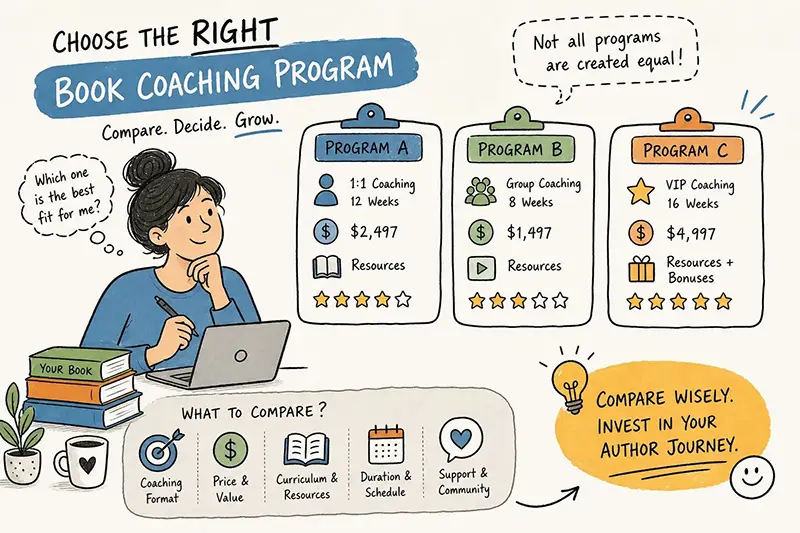
When doing a book coaching programme comparison, the single biggest fear I hear from first-time nonfiction authors isn’t “Can I write a book?” It’s “What if I invest in the wrong programme and have nothing to show for it?” That fear is completely valid. The coaching market is crowded, pricing varies wildly, and the difference between a coach who helps you finish a credibility-building book and one who leaves you with a half-written draft isn’t always obvious upfront.
The problem is compounded by the way these programmes are marketed. Most sales pages lead with transformation promises and glowing testimonials, not a clear breakdown of what’s actually included, what the coach’s background is, or what you’ll have in your hands at the end. Without a framework to compare options, it’s easy to choose on price alone or based on a compelling discovery call.
At Business Author Academy, I work with coaches, consultants, and business professionals who want to get their book right the first time. I’m Jennifer Lancaster, author, editor, and publishing mentor, and this guide gives you a practical framework to compare book coaching programmes confidently, evaluate what’s actually included, ask the questions that matter, and shortlist the right fit for your stage and budget.
The four formats you’ll encounter in a book coaching programme comparison
One-to-one coaching: the highest-touch option
Private coaching is the most personalised format available. You work directly with one coach through regular sessions, receiving tailored manuscript feedback and guidance from idea through to draft. This is the highest-investment option, and it suits authors who want close, sustained support throughout the full writing process, particularly when the book is tied directly to a business or personal brand. The coach adapts to your pace, your voice, and your specific challenges rather than delivering a fixed curriculum to a room full of strangers.
Comparing group and hybrid book coaching models: structure with peer accountability
Group programmes run as cohorts: a coach leads a fixed curriculum across live sessions, typically via Zoom, and peer accountability forms a central part of the experience. Hybrid models add periodic one-to-one check-ins on top of the group container. Both formats cost less than private coaching and offer genuine community value. The trade-off is that peer input rarely replaces expert editorial feedback on a manuscript. If your book is tied to a consulting practice or a professional services business, you need more than encouragement from fellow writers at a similar stage of development.
Intensives and short-burst formats
Intensives compress support into a focused window, designed for a specific breakthrough: structuring an outline, troubleshooting a stalled draft, or making a publishing decision. These are useful for authors who know precisely what they’re stuck on. They are not a substitute for sustained coaching through the full writing and launch cycle. If you’re starting from scratch or need to move from first draft to published book, you’ll need more ongoing structure than a single sprint can provide.
What a quality programme genuinely covers from first word to launch
Writing support and real editorial depth, not just encouragement
Meaningful writing support means developmental feedback on structure, chapter flow, voice, and reader transformation arc. It is not the same as motivation, accountability calls, or general encouragement. Ask directly whether the coach or a team member has manuscript editing experience, because coaching experience and editorial experience are different qualifications. A coach without editorial skills can leave you feeling supported, while your manuscript still has structural problems that will require expensive remediation further down the track.
Publishing knowledge and launch strategy most coaches skip
Many writing coaches stop at the manuscript. A quality programme should take you further, covering self-publishing pathways, Amazon KDP, book marketing strategy, launch sequencing, back matter, and how the book connects to your business model. This is the layer that turns a finished manuscript into a lead-generation tool rather than a creative project sitting in a drawer. Without it, you’ll finish the book and then face a second, equally confusing journey through publishing and marketing with no guide beside you.
How we cover all three under one roof at Business Author Academy
At Business Author Academy, I offer exactly this full-spectrum support across writing, editing, and publishing. One-to-one coaching covers voice development, outline construction, habit-forming, and sustained encouragement through the writing process. Comprehensive editing runs from developmental feedback through to final proofread. The publishing and marketing layer includes Amazon A+ graphics, launch reels, email list guidance, and ready-made marketing templates. Most programmes deliver one or two of these layers. Getting all three in one place is rare, and it’s the benchmark you should use when evaluating any book coaching programme you’re considering.
Questions to ask every coach before you commit
About credentials, track record, and client outcomes
Ask specific questions before you hand over a deposit. Have you written or edited published nonfiction books? Can you name clients who completed manuscripts and achieved a clear publishing outcome? What training or certification do you hold, and what does it actually cover? Credentials don’t require a specific degree, but coaches should be able to describe their process in concrete terms and point to real client results, not just testimonials full of vague praise. If a coach struggles to answer these questions clearly, that is an answer in itself.
About what’s actually included in the package
Clarity here protects you from scope surprises later. Ask how many sessions are included. Find out whether manuscript feedback is written or verbal, whether editing support is part of the package and at what stage it kicks in, and what happens if you fall behind schedule. Establish whether marketing or publishing guidance is built in or comes at an extra cost. Coaches with well-structured programmes can answer these questions without hesitation. Coaches who can’t are usually delivering something looser than what the sales page implies.
About contract terms, timeline, and exit options
Ask what the written agreement includes. Cover payment terms, refund policy, manuscript ownership, and whether a termination clause exists if the fit isn’t working. All publishing rights belong to you as the author, not to the coach. A coach who provides a clear, detailed contract is demonstrating professional structure. Coaches who resist putting terms in writing are a serious concern, regardless of how compelling their testimonials appear.
Red flags that should make you keep looking
Vague transformation promises with no defined deliverables
If a programme sells the outcome (“become a published author!”) without specifying what you’ll actually receive, proceed with caution. Look for concrete milestones, a written list of deliverables, and clarity on what “done” looks like at three, six, or twelve months. A programme that can’t describe its deliverables in specific terms doesn’t have the structure to deliver them reliably, and you’ll be the one absorbing the cost of that vagueness.
No editorial or publishing experience in their background
A strong nonfiction book coaching programme requires someone who understands how manuscripts are structured, what makes a book publishable, and how it connects to a business goal. General life coaching certifications or memoir writing experience doesn’t automatically transfer to nonfiction business books. Ask what their editing background is. Ask whether they’ve navigated a self-publishing platform for a client. The answers will tell you quickly whether you’re talking to a genuine book-building strategist.
High-pressure sales tactics, no contract, or vagueness
Watch for urgency pressure, reluctance to provide a written agreement, vagueness around editing fees, or a discovery call that functions as a sales pitch with no space to ask your questions. A coach who treats the intake process as a transaction rather than a mutual fit assessment is not going to prioritise your manuscript. The discovery call is a two-way evaluation. If it doesn’t feel that way, trust that instinct.
Matching the right programme to your stage and budget
Where you are in the manuscript determines which format fits
Your manuscript stage should drive the decision, not the price or the personality of the coach. At the idea stage with no outline, you need developmental and structural support above everything else. If you have a draft that’s going nowhere, you need editorial depth, not more accountability calls. If you’re close to a finished manuscript, you need publishing and launch guidance. Programmes that don’t ask about your stage before offering you a package aren’t tailoring the fit. They’re selling a product.
What different book coaching costs actually buy in Australia
In Australia, lower-cost group programmes in the A$500 to A$1,500 range typically offer curriculum and community and limited individual manuscript feedback.
Mid-range packages in the A$3,000 to A$6,000 range include a defined coaching container with some one-to-one sessions.
High-touch, full-spectrum programmes at A$8,000 and above typically cover writing, editing, and launch strategy together. %10,000+ includes publishing.
The lowest price is not always the worst value, but a programme that under-delivers on editorial depth will cost more in the long run, in revision fees, delays, and the slow erosion of confidence that comes from publishing a book that wasn’t ready.
A real scenario: what happens when a business coach writes alone
Consider a leadership consultant with 15 years of experience who sits down to write her book without support. She has the expertise. She has the ideas. But six months in, she has 40,000 words that don’t hang together, three different audiences she hasn’t chosen between, and no idea how to position the book for Amazon. She hires a budget writing coach because the price feels safer. She gets ten more sessions of encouragement but no structural edit. Two years in, she is still unpublished and wondering whether the book was ever a good idea. In my experience working with business authors, this pattern appears more often than any other, and it is entirely avoidable with the right programme from the start.
The bottom line on comparing book coaching programmes
Comparing book coaching programmes comes down to four things: format match, depth of support, coach credentials, and contract clarity. The right programme for you depends on your manuscript stage, your budget, and whether the coach’s expertise spans writing, editing, and publishing, not just one of those layers in isolation.
Before you commit, ask for specific deliverables, a written agreement, and real client outcomes. Use the red flags in this guide as filters, not afterthoughts. The questions exist because the wrong investment doesn’t just cost money; it costs momentum, and momentum is the one thing first-time authors can least afford to lose.
If you want to see what a full-spectrum book coaching programme looks like in practice, book a discovery call with Business Author Academy. I’ll ask about your book, your business goals, and your timeline so we can work out together which level of support makes the most sense for where you are right now.