
Let’s get one thing straight first: nobody – not a legitimate traditional publisher, not a reputable hybrid, not a decent book coach – is going to turn your manuscript into a real, bookshop-worthy, professionally produced book for the price of a nice pair of shoes. If someone’s offering to do it for $399, or $999, or even $1,999 with “global distribution and marketing included”, the maths should be setting off alarm bells before the sales pitch even finishes.
I’ve watched this corner of the industry for 15 years, and lately it’s gotten worse, not better. A wave of slick, ‘similar name to legitimate’ outfits, like Queensland Book Publishers, Australian Publishing Press, and – my personal favourite for sheer audacity – Penguin Publishers, are hoovering up first-time authors who just want someone, anyone, to believe in their manuscript.
So let’s talk about what’s actually going on.
The Reviews are the First Clue — and Also the Publishing Scam
Just like large vanity presses, these smaller Australian publisher operations look legitimate. Professional website, warm copy about “your story, our passion,” a “Meet the Team” page full of smiling, well-lit executives and editors. And a wall of five-star reviews.
That last part should worry you more, not less. When I went looking, I found many websites or FB Pages of these fake Australian Publishers portray a suspiciously tidy run of near-identical glowing testimonials — the kind of well-written enthusiasm real customers rarely produce in bulk.
Researchers looking into a related network of fake publishing houses targeting Australian authors found the same pattern: websites claiming to have been established decades ago when a domain search showed the site was registered only a month earlier, alongside a suspiciously high Trust Pilot rating attached to a listing that had no genuine reviews at all. Even the staff photos weren’t real — the “team” pages were populated with AI-generated images of impossibly polished executives.
And then there’s Penguin Publishers — not to be confused with the actual Penguin Random House, one of the “Big Five” global publishing houses. The imitation is deliberate. Dig past the curated five-star reviews and you find a very different story: authors describing manuscripts returned full of uncorrected errors after paying hundreds for proofreading, royalties that simply stopped arriving, and demands for thousands more dollars to keep a project moving. The real Penguin Random House has gone so far as to list this impersonator on its own official fraud alert page. When the actual global publisher has to publicly disown a company trading on its name, that tells you everything.
This Fake Australian Publishers Pattern is Getting Worse
None of this is new, and it isn’t confined to Queensland or Penguin fakers. It’s a well-worn playbook, and it’s spreading fast with the help of AI tools and bots that make it cheaper than ever to fake credibility at scale. Industry watchdogs have flagged the warning signs for years: you’ve never heard of the publisher before, you don’t recognise any of their published titles or authors, you’re asked to pay money upfront disguised as a “reading fee” or “copyright registration”, your contract requires you to buy a set number of your own books, or they flatly guarantee to make you a bestseller.
These operators pour money into polished websites, Facebook ads and Google ads to claim the top search results for terms like “Australian publishers accepting submissions” — and only Reddit will show actual reviews of customers (see below).
The advice from those who track this closely is refreshingly simple: get independent advice before signing anything that asks for money upfront, check whether the publisher’s titles actually turn up in a bookshop or on a retailer like Booktopia, and Google the publisher’s name alongside “customer reviews” — a wall of negative reviews buried past the sponsored positive ones is a serious red flag.
So no, I’m not being dramatic. This is a real, documented, growing problem — and it preys specifically on the excitement and vulnerability of someone who has just finished writing a book and desperately wants it to matter.
What Should Actually Happen When You Publish
Here’s what none of these outfits are offering, and what genuinely matters: you should own your ISBN. You should own your design files. Full stop. If a “publisher” holds your ISBN, your cover files, your interior layout hostage – then you don’t own your book. They do. You’re a customer of a service that can vanish overnight, taking your royalties, your rights, and your only copy of the print-ready file with it.
Xlibris is no better – they hold your metadata at Amazon, and from what I can see they pay no heed to terribly written blurbs or author websites.
This is precisely why I built Self-Publish and Own It the way I did. You work one-on-one with an experienced editor — me — not a rotating cast of account managers who’ve never read your manuscript. You keep your own ISBN. You keep your own files, in full, the moment we’re done. No holding your book hostage, no mystery royalty statements, no vanishing acts.
I’ll be honest — it’s not for everyone. If you want someone else to make every decision and hand you a finished product with zero involvement, this isn’t that. But for the nonfiction author who wants a real say in their own book, and wants to walk away actually owning what they paid for, it’s about as far from a Queensland Book Publishers situation as you can get.
For the entrepreneur playing a bigger game — more sophisticated distribution, more hands-on support building the book into a business asset — that’s Business Publishing Direct, the next tier up.
Long-term view, if you want help to achieve the full online empire — book, author website, taglines, a proper sales funnel, and the editing to back it all up — that’s bundled at a genuine discount in what I (unglamorously but accurately) call the Publishing Mega Offer. More on that next time.
The Real Reason this Matters: Royalties Alone Won’t Get You There
Here’s the reframe of this whole conversation. Most authors chasing a “publisher” are quietly hoping the book itself will make them money. It mostly won’t, not through royalties alone. A 33-cent-a-read Kindle royalty is not a business model. (Just watched a video and the author spent $2,300 advertising his novel just to make 63 sales at $3 – 4 royalty).
The authors who actually reach that rarefied $50,000–$100,000-a-year income bracket from their book aren’t living off royalties. They’re using the book as the front door to a handful of other income streams:
- Substack subs or digital products built from the book’s content — the book teaches the “what”, the resources or course sells the “how”.
- Paid speaking and workshops — the book is the credibility card that gets you booked.
- Coaching or consulting — readers who finish your book and want the tailored version of it, one-on-one.
- Licensing or corporate/media deals — content, frameworks, or your story sold or syndicated into a second context entirely.
The book isn’t the payday. It’s the credential that unlocks the payday. That’s the whole game — and it’s exactly why owning your ISBN and your files matters so much. If you’re going to build an entire income strategy on top of your book, you’d better make sure nobody else can hold it hostage.
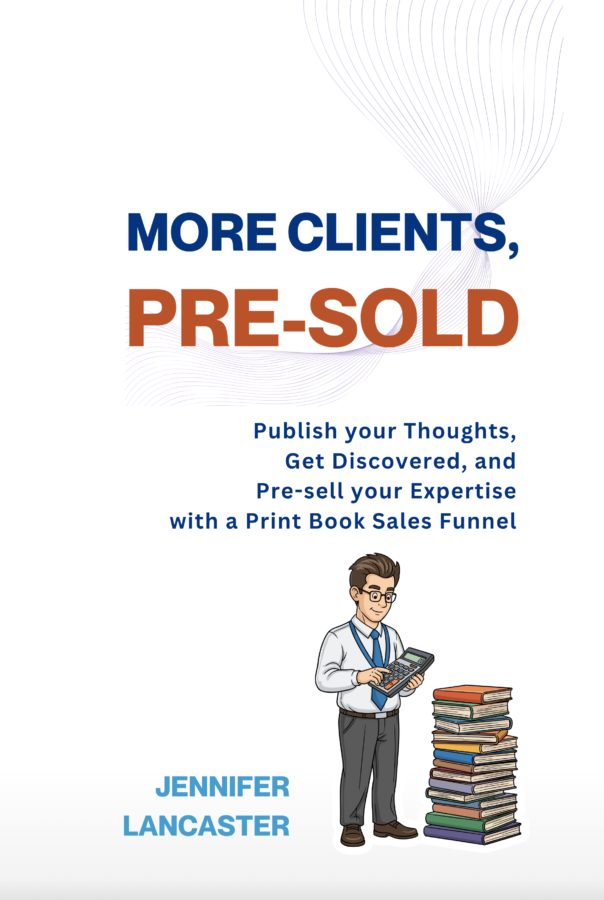
All my secrets to this ‘direct sales funnel’ method are contained in ‘More Clients, Pre-Sold’:
So before you hand over $399 — or $3,999 — to a publisher you found via a Facebook ad, do the boring due diligence: search the name, check the reviews past page one, and ask who actually owns the files at the end. Your book deserves better than a fake five-star review farm. So do you.
Some punter on Reddit asked: Is Penguin Publishers part of Penguin Random House Group?
Answer from Orion_004: “That is a 100% scam site. Calling them a vanity press would be too generous. The very fact that they’re trying to deceive customers into thinking they’re Penguin Books raises a huge red flag and puts them firmly in the SCAM category.”