
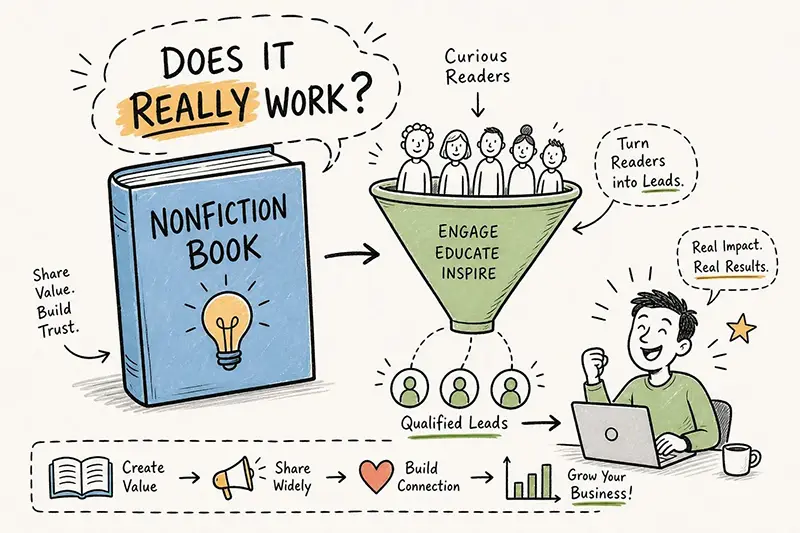
The fear is real, and omnipresent. A first-time nonfiction author sits across from me on a discovery call, idea in hand, and asks the question they are almost embarrassed to say aloud: “What if I publish this book and nothing actually happens?” They have seen colleagues post about their books, watched the social media flurry at launch, and quietly wondered whether any of it moved the needle for the business. It is a completely valid concern, and nonfiction book lead generation is the strategic answer to it.
If not giving thought to how an expertise-based book can work as a lead-generation asset, you take on the risk of it fading into obscurity once launched. But here is what those same authors rarely see: the ones who treat their book as a business tool, not a creative project, tend to report a very different outcome.
Nonfiction book lead generation is not a marketing myth. The evidence is measurable, the benchmarks exist in practitioner literature, and the funnel is replicable. At Business Author Academy, every manuscript project starts with two questions before a single chapter is drafted: who is this book supposed to attract, and what should they do next? The rest of this article is the proof you need before you commit to writing yours.
Why a nonfiction book is one of the highest-trust lead tools available
Social posts have a short algorithmic lifespan, often measured in hours rather than days. A paid ad disappears the moment your budget stops. A book sits on a shelf, gets passed to a colleague, and gets read on a long-haul flight months after someone first picked it up at a conference. The compounding nature of a book as a marketing asset is genuinely different from every other channel a coach or consultant typically uses, and the trust data backs this up.
A study published in early 2026 found that 89% of respondents trusted content more when it was created by a published author. The same study reported that 88.8% preferred content from an industry expert who had written a book over one who had not, a finding the researchers framed as a 7.9x trust advantage. Respondents also expected to pay an average of 37% more for a consultation with a published author, with expected rates of $345 versus $251 when qualifications were otherwise identical. For coaches and consultants in high-investment niches, that premium is not a small detail. (The full methodology and sample details are available in the primary report; contact the academy for the citation.)
The distinction worth drawing is between a book and a campaign. A campaign has a start date and an end date, and its lead-generation effect ends with it. A book can have a long tail of discovery and lead generation compared with a single social post, meaning the authority it signals and the leads it generates may continue to accumulate long after publication, without additional spend. That represents a fundamentally different return on effort.
The lead journey from reader to client, and where most authors lose the thread
Think of trust as a ladder. A prospect moves from stranger to reader, then from reader to engaged follower, and finally from engaged follower to paying client. A well-designed nonfiction book earns the first two rungs faster than almost any other marketing tool available to a service-based business owner. The problem is that most authors publish and then do nothing to guide the reader to the next step. They leave the ladder with the top rungs missing, and then wonder why clients are not calling.
A case study: the coach who almost gave up halfway through
The following is an anonymised account from a client engagement at Business Author Academy. A business coach came to me mid-manuscript, genuinely close to abandoning the project. She was convinced her topic was “too niche” to attract enough readers, and she could not see how a book about her specific methodology would ever translate into client enquiries. We pushed through the editing stage together, refined her back matter, and built a simple companion resource to pair with the launch. Within three months of publication, she was receiving consultation enquiries from readers she had never met. One of them told her he had carried the book in his bag for four months before finally reaching out.
That four-month gap is not a failure of the funnel. It is the funnel doing exactly what it is supposed to do. A book reader self-qualifies over time. By the time that prospect booked a call, he had already absorbed her methodology, aligned with her approach, and decided she was the right fit. The conversation moved from introduction to proposal in a single session, at her full consulting rate.
Nonfiction book lead generation: back-matter tactics that convert
Most nonfiction authors treat the back matter as a formality: a brief author bio, maybe an acknowledgements page, and a vague “find me online” note. That is one of the most significant missed opportunities in the entire publishing process. The back matter is the last thing a motivated reader sees, and a motivated reader is the closest thing to a warm lead you will encounter in your business.
Practitioner sources consistently recommend four back-matter elements for driving qualified enquiries:
- A clear next-step invitation, whether a discovery call, a consultation, or a resource page, that is explicit and specific rather than vague.
- A direct booking link or QR code that removes friction between intent and action.
- A brief services summary framed in terms of the reader’s transformation rather than your credentials, reminding them the conversation can continue beyond the page.
- A short outcome statement or testimonial that anchors the credibility signal at exactly the moment the reader is deciding what to do next.
The difference between a passive author bio and an active conversion prompt comes down to specificity. “Jane Smith is a business coach based in Melbourne” does nothing for the reader who has just spent six hours with Jane’s thinking and wants to know what to do next. An active prompt speaks directly to where the reader is: “If you recognised your own situation in Chapter 4, a deep dive call can map out your next 90 days.” That is the version of back matter that books consulting slots.
At Business Author Academy, we recommend this offering is built as part of the reasoning and structure, not as a last-minute addition, because the call to action needs to connect directly to the book’s central promise.
Nonfiction book lead generation funnel: the sequence that connects your book to booked calls
The sequence that works for authorpreneurs and business coaches follows three clear stages: opt-in, nurture, offer. The book, or a companion lead magnet tied to the book, captures the email address. A short nurture sequence builds familiarity and delivers value. The offer, usually a discovery call or a webinar, closes the gap between reader and client.
Pairing your book with a companion resource is the mechanism that makes the opt-in stage work. See how a startup author/professor did this well on our blog. The right format depends on your niche. For business, productivity, and finance books, checklists and templates tend to convert at opt-in rates of roughly 8% to 14%, based on observed practitioner benchmarks. For coaching, leadership, and personal development titles, assessments and quizzes frequently outperform other formats, opt-in rates ranging from 30% to 50% have been documented in this category because they personalise the reader’s next step. Generic PDFs consistently underperform, so if you are going to build a companion resource, make it specific and actionable rather than simply a condensed version of the book itself.
The tools that make this funnel practical are neither complicated nor expensive. A landing page builder such as Systeme.io or Leadpages, an email platform such as Kit (.com) or MailerLite, and BookFunnel for delivering the companion resource can have the infrastructure operational in a matter of days. The point is simplicity: a clean, low-friction path from book to inbox to booking page is what converts, not a sophisticated automation system.
What the data says about book-to-client conversion rates
Setting realistic expectations matters, because the authors who measure their funnel are the ones who improve it. Based on industry benchmarks, warm author email lists convert at 2% to 5% for book purchases, with strong launch campaigns reaching 5% to 10%. Open rates for author newsletters sit at 22% to 30% on average, with engaged lists reaching 30% to 40%. (These figures are drawn from platform benchmark reports; individual results will vary by niche and list quality.)
One of the more striking examples of book-based email list building is the Huberman Lab “Daily Blueprint” lead magnet, which generated over 580,000 subscribers with an 82% open rate on the welcome sequence, though it is worth noting that no book-purchase conversion rate from that list has been publicly reported. That list became the foundation for promoting Andrew Huberman’s book Protocols. The scale is exceptional, but the mechanism is identical to what a consultant with a targeted list of 3,000 ideal readers can achieve: a focused, engaged audience who already trusts the methodology before an offer is made. A smaller list of the right readers will often outperform a large general audience at most stages of the funnel, particularly at the conversion stage where relevance matters most.
The delayed lead, the prospect who reads your book and contacts you weeks or months later, is often the highest-value lead in your funnel. Because they have self-qualified over time, the path from first call to paid engagement is frequently more direct than it is with cold traffic, and commonly at a higher price point. The book is doing qualification work in the background without any additional effort from you.
What it takes to build a book that generates leads, not just reads
The authors who see genuine business outcomes from their books share one characteristic: they made lead-generation decisions before they finished their main draft. The back matter, the companion resource, the automated email sequence, and the call to action were all mapped early on, not retrofitted after a sudden realisation there’s no link to their business. For newer consultants, that distinction matters.
The common sticking point is that most authors know their subject deeply but have not been shown how to build a book that functions as a business tool. They write from expertise and then find that the business outcomes do not follow automatically. Business Author Academy was built specifically to close that gap. Australian editor Jennifer Lancaster works with coaches, consultants, and service-based business owners to build manuscripts where the author lead generation strategy is embedded from chapter one, so the book earns its place in the business from the moment it lands in a reader’s hands.
If you are ready to build a manuscript with lead generation embedded from the first outline session, book a discovery call with Business Author Academy and map out your book funnel strategy before you write a word.