
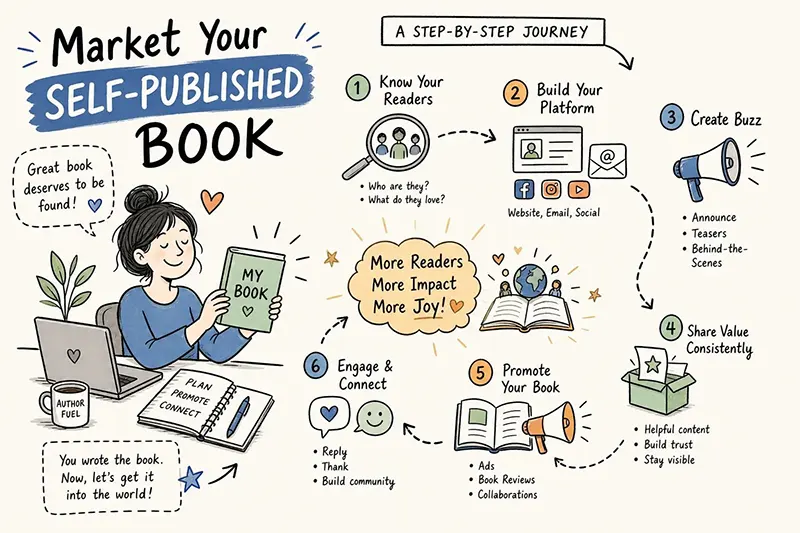
Learning how to market a self-published book is often more daunting than finishing the manuscript itself. The most common fear I hear from new authors isn’t “What if no one likes my book?” It’s quieter than that: “What if no one even sees it?” That fear is well-founded, because finishing a manuscript and marketing a published book are genuinely two different skills, and most first-time authors discover this the hard way.
I noticed an older business owner self-published a book about success. He announced it on LinkedIn on release day, likely sent it to all his long-term partners, and true sales would probably have been <100. That result wasn’t a reflection of the book’s quality and value, it was the inevitable outcome of treating the launch as an afterthought. At Business Author Academy, this is why I take a proactive book launch planning approach.
Promoting a self-published book isn’t about being a pushy salesperson or flooding social media with buy links. It’s about putting a great book in front of the right readers in a sequenced, repeatable way. The four-step framework below is what I use with every client, and it works whether you’re starting from scratch or relaunching a book that didn’t get the debut it deserved.
Step 1: Optimise your Amazon listing before you spend a cent on promotion
Categories and keywords
Amazon functions as both a search engine and a bookshop. Categories place your book on the right digital shelves so browsers can find it; keywords match your title to what readers actually type into the search bar. Choose three accurate, specific categories and fill all seven keyword fields with real search phrases your target reader would use, not broad generic terms like “business” or “self-help.” This is foundational book publicity for indie authors, and skipping it means every promotional dollar you spend later works against a weaker foundation.
Your blurb and Amazon Author Central profile
Your blurb is your sales page, and a weak one will waste every dollar you spend on promotion. Structure it with a hook, a clear promise, short paragraphs, and a direct statement of reader benefit. Once the blurb is tight, turn your attention to your Amazon Author Central profile. Add a professional bio, a photo, and any editorial reviews. Most authors can complete the profile in under an hour, and it creates the kind of author presence that converts a curious browser into a buyer.
Step 2: Market a self-published book by building your email list before launch day
Why email outperforms social reach
The coach from my example had no email list at all when her book went live. That meant no warm audience to notify, no anticipation to build, and no way to follow up after that single LinkedIn post disappeared from people’s feeds. Your email list is the infrastructure that makes every other marketing activity work. As an indie author marketing strategy, it is the one channel you own outright, no algorithm can take it from you.
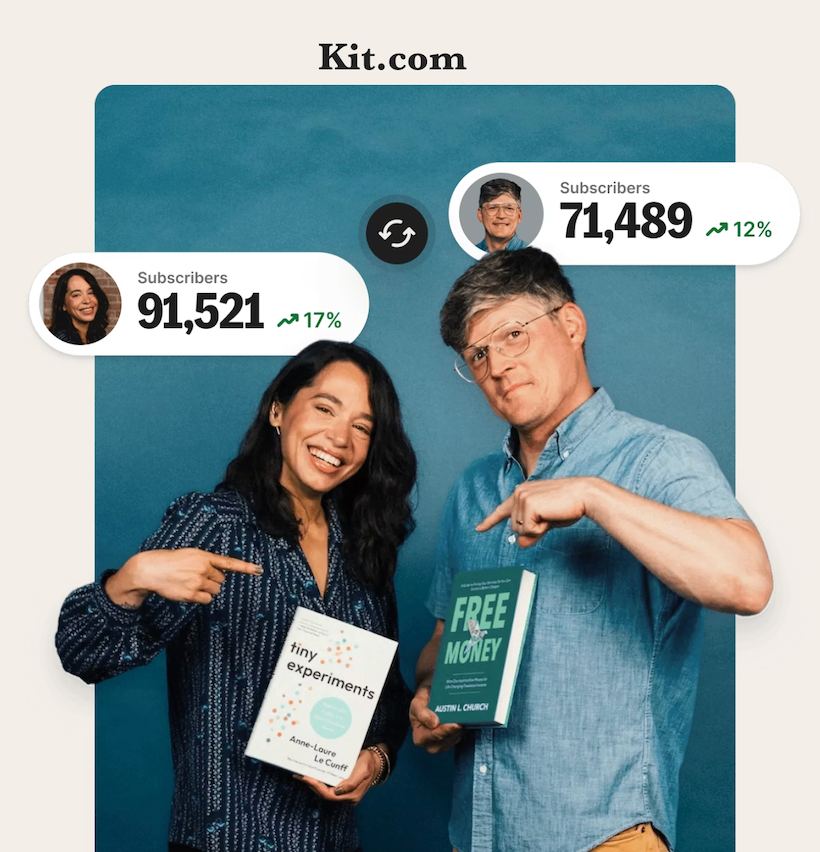
We like Kit.com and Systeme.io for first-time author-entrepreneurs. Email Marketing platform ‘Kit’ helps with the grunt work of adding subscribers, recommends, and WP website forms, while Systeme can take care of a private book sales delivery funnel at zero cost. Knowledge and setting up is still required, of course.
Reader magnets and welcome sequences
Create a reader magnet: a free, high-value resource your ideal reader genuinely wants. For nonfiction business authors, a diagnostic worksheet, an implementation checklist, or a short workbook tied directly to the book’s core promise performs best. Place the signup link in your book’s back matter, on your website, and in your social bios.
Pair the lead generation magnet with a simple three-to-four-email welcome sequence:
1. Delivery of the magnet
2. The story behind the book
3. A preview of the key ideas, and
4. A direct invitation to buy or review
A targeted list of 400 engaged readers will generally outperform a cold audience of 10,000, because warm (3-months-in) readers who already trust you convert at a far higher rate. The exact numbers will vary by niche and offer, but the principle is: quality of connection matters more than raw list size.
This sequence runs automatically and converts new subscribers into readers without requiring daily effort.
Step 3: Run a co-ordinated launch campaign, not a single post
Building your advance reader team
Recruit 20 to 40 genuine readers before launch, provide them with an advance copy, and ask for an honest review on release day. You can even use Media Releases through a portal like MediaNet or SourceBottle for this. SourceBottle has a low-cost introduction pane, rather than pitching for stories you see.
Kindlepreneur advises that 20 to 25 reviews create a strong foundation for advertising. Never fear: 10 to 15 authentic reviews mark the first meaningful improvement in Amazon conversion rates. I’ve learned that people just don’t volunteer reviews without a couple gentle prompts — or one of those online reader-reviewing systems.
Never incentivise positive reviews for five stars. The ethical approach is also the effective one, because a cluster of genuine reviews, adequately spaced, carries the book visibility level for months. This kind of coordinated book promotion strategy is much better than trying to game the Amazon system.
Launch-week checklist
Structure your launch week as a sequence – remembering to send previous value-packed emails. Suggestion:
- A pre-launch warm-up email to your list
- A launch-day email with a direct purchase link
- A mid-week follow-up sharing early reader responses
- A final-day urgency email
Coordinate this with social posts, any Kindle Countdown Deal you plan to run, and podcast or newsletter outreach you have already arranged. Business Author Academy’s ready-made marketing templates and launch reels are pre-built for exactly this sequence, covering email copy, social graphics, and short-form video scripts designed specifically for self-published business authors. Authors who use these assets typically avoid weeks of build time that would otherwise go into creating materials from scratch.
Step 4: Track three numbers for 90 days
What to measure and why
Social likes and impressions are lower-value vanity metrics compared with the conversion measures that actually predict book sales. Optimising for them pulls your attention in the wrong direction. Track paid sales by retailer, email list growth rate, and review count. These three metrics tell you whether your discovery channel, your owned channel, and your conversion events are working together. Update a simple tracking sheet weekly and let the data drive every decision.
Refining your tactics after the first 30 days
After the first 30 days, identify which one or two activities produced measurable results and invest more in those. If podcast guesting generated new email subscribers consistently, book more podcasts. If a Kindle Countdown Deal spiked sales but read-through was low, investigate the listing before running another one. The 90-day plan is not about doing everything, it’s about finding the two tactics that fit your book, your audience, and your schedule, then repeating them with consistency.
Ready to build your book marketing system?
Knowing how to market a self-published book comes down to four decisions made in the right sequence: get the Amazon listing right [see our A+ Content post], build an email list before launch day, run a campaign with real reviews in place, and track three simple numbers for 90 days. That framework is going to give you reachable actions — and a book that builds a readership. It’s also a repeatable book marketing checklist you can apply to every title you publish going forward.
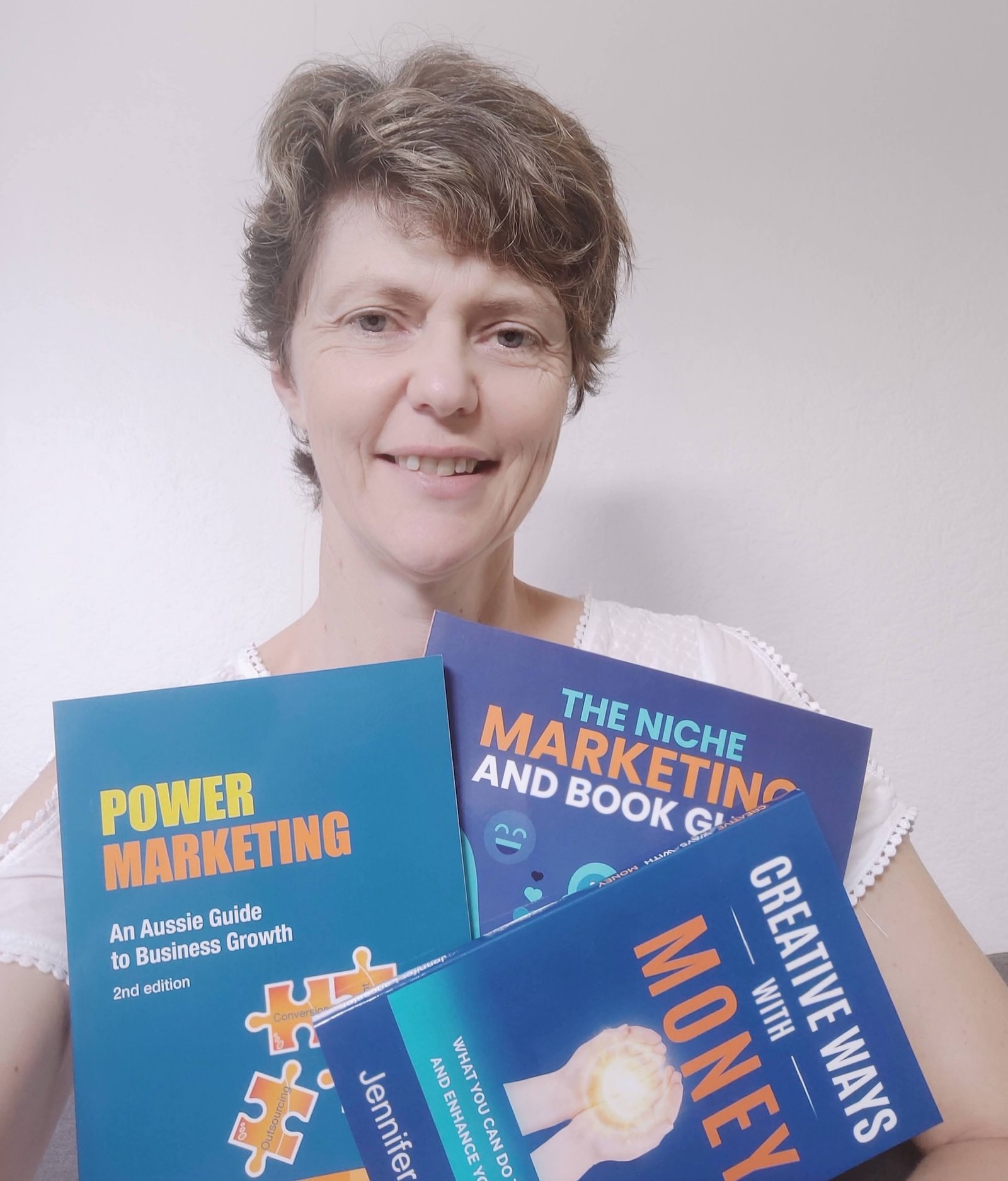
I once added about 75 more subscribers by offering an hourly rate calculator (just Excel), who were freelancers and potential candidates to buy my aligned book about freelancing. Some thinking outside the box can make all the difference.
If that sounds like the system you need, Business Author Academy’s book marketing templates, launch reels, and one-to-one mentoring are built precisely for this. A discovery call is the right first step to finding the level of support that fits your book and your goals.