
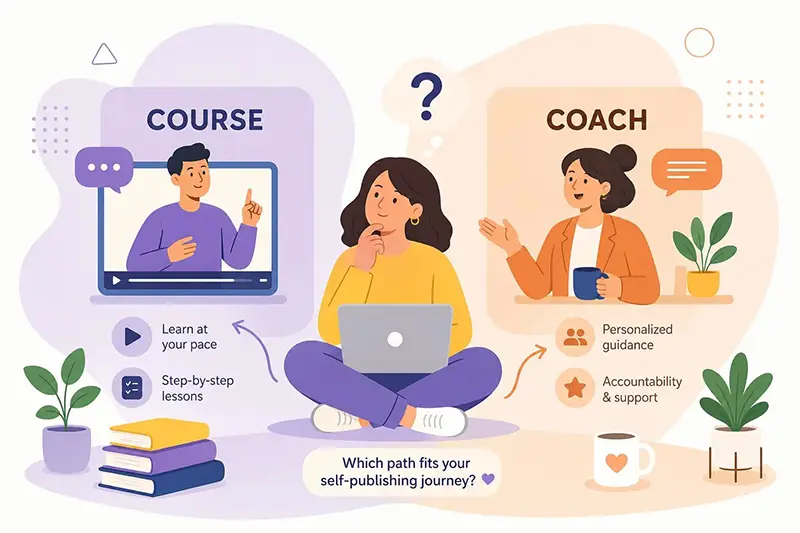
Almost every first-time nonfiction author carries the same quiet fear: What if I spend money on support and still don’t finish the book? It’s a reasonable fear, and one I see surface constantly through my work at Business Author Academy. Choosing between a self-publishing course vs a book coach is one of the most common dilemmas authors face, and one that’s worth thinking through carefully before you commit. Authors arrive having already spent hours researching their options, often more paralysed by the decision than by the writing itself.
Here’s what I’ve observed after working with dozens of nonfiction authors: the wrong choice almost never comes down to a bad product. It comes down to mismatched expectations. A self-publishing course gives you a structured process to follow. A book coach gives you someone who walks that process with you. Both are legitimate, and both genuinely work, for the right author at the right stage. This article breaks down the honest differences in cost, outcomes, and fit so you can choose with clarity.
What you’re actually buying with each option
What a self-publishing course delivers
A self-publishing course is a pre-built system. You view structured online modules covering the mechanics of publishing: planning your book, formatting your manuscript, understanding legal basics, setting up on platforms like Amazon KDP, and mapping out a prelaunch strategy. Most courses are self-paced, with access periods of twelve months or more, and many include templates, workbooks, or a community forum. The content is standardised and delivers a consistent experience to every student who enrols, which is its strength when your gap is process knowledge.
The value is entirely contained in the system. The value in our course is teaching you about outlining and a tool for launch planning, not just learning about IngramSpark and Kindle Publishing. It is a free bonus with any book coaching program by Jennifer Lancaster.
What a book coach provides instead
A book coach (or writing coach) works directly with your manuscript, your goals, and your timeline. In practice, this looks like regular sessions, developmental feedback on your chapters, check-ins, help when you hit a wall, and publishing guidance tailored to your genre and audience.
The relationship is the product: the coach adapts to you, reads your draft, and responds to the specific problems your book is creating. Many coaches also weave editorial support alongside the coaching work, so you’re getting structural feedback and craft guidance in the same engagement. It’s a form of author mentorship that goes well beyond what any recorded module can offer. Business Author Academy takes this integrated approach, combining coaching with editorial input so authors receive both strategic direction and manuscript-level feedback.
With fifteen years’ in book writing (how-to and self-development), our commercial audience targeting help is derived from ‘trialling and doing it’ experience.
The real cost breakdown: self-publishing course vs book coach
Course pricing: what you get at each level
In the Australian market, short introductory courses typically run between AU$200 and AU$300. More comprehensive programmes, with modules, templates, and some level of instructor access is in the AU$1,000 to AU$3,000+ range. What moves the price is module depth, whether there’s any live feedback element, the quality of the included resources, and the track record of the provider. A lower price point isn’t automatically a lower-quality choice.
Book coach rates and how packages work
Hourly coaching rates range from roughly AU$70 to AU$250 per hour, depending on the coach’s experience and specialisation. For full manuscript support, project-based packages span from AU$1,500 to AU$30,000. We sit in the good value end, from $3,000 to $4,400 including developmental editing.
Many nonfiction authors opt for structured packages rather than open-ended hourly arrangements, which makes costs more predictable and the scope clearer from the outset. The higher investment reflects the personalisation and time commitment involved. A coach who reads your chapters, responds to your specific positioning challenges, and shows up consistently over months is delivering something a recorded module simply cannot replicate. If you need a truly hands-off route, done-for-you publishing services exist as a third option, though they sit at a different price point again and transfer most of the creative decisions away from you.
Which authors get the most from a self-publishing course
The conditions where a course works well
A self-publishing course is a strong fit if you’re self-directed, already have a clear book concept, and your main gap is process knowledge rather than creative or strategic guidance. If you know what your book is about, you have time to work through modules independently, and you primarily need to understand publishing mechanics, formatting, platform setup, metadata, distribution, a course will serve you well. It’s also an excellent entry point for authors on a tighter budget who want to build foundational knowledge before deciding whether to invest in author coaching.
Where courses tend to leave authors stuck
A course cannot tell you whether your chapter structure is actually working. It cannot help you reframe your positioning when your book feels generic against twenty others in your category. It cannot read your introduction and tell you honestly that you’ve buried your best insight on page four. Research consistently puts the completion rate for self-paced online courses at around ten to twenty per cent, not because the content is poor, but because information without accountability rarely drives implementation. Many authors finish the modules, feel informed, and then stall when it comes to applying that knowledge to their specific manuscript and business goals.
When a book coach is the smarter investment
The author who needs more than instructions
There’s a specific type of author I see repeatedly: experienced in their field, clear on their expertise, but deeply uncertain how to translate that into a manuscript that positions them well and attracts the right clients. That author doesn’t need more information about publishing platforms. They need someone to look at their outline, read their draft chapters, and give them an honest assessment of what’s working and what isn’t. Author coaching accelerates the decisions that stall solo authors for months, sometimes years. If your gap is strategic and creative rather than procedural, a self-publishing course will give you capability without follow-through.
A real author story: what changed with coaching
Consider the experience of a business consultant, call her Sarah (a composite drawn from common coaching scenarios), who enrolled in a self-publishing course with a solid book idea and genuine motivation. She completed the first two modules, felt confident, and started writing. By chapter three, she’d stopped. The course had answered her questions about formatting and Amazon KDP, but it hadn’t answered the question she needed to resolve: how do I position this book to attract premium corporate clients rather than just general readers?
That question required someone to look at her content, understand her service model, and give her a direct answer. Once she moved into 1-to-1 book coaching, she had a published manuscript within six months. The course gave her knowledge; the coaching gave her a finished book.
Questions to ask before you invest in either
What to check before enrolling in a course
Before you pay for a self-publishing course, verify that it covers your specific publishing path, self-publishing and traditional publishing require very different knowledge. Check whether there is any live instructor access or whether you’re buying pre-recorded content only. Check out any linked books from students/testimonies. Confirm the curriculum is current, particularly around Amazon KDP updates and metadata strategy, which shift regularly. Ask specifically what the course does not cover, because that gap might be precisely where you’ll get stuck.
Remember to look for Australian-relevant content. It even saves time, due to our ISBN provider being a different website and having different prices.
Credentials and red flags to watch for in a coach
For coaches, the vetting process needs to go deeper. Ask about their background in your genre specifically: a fiction coach and a nonfiction business book coach are very different practitioners with different skill sets. Ask to see published books from their clients. Request references you can contact independently. A credible coach will have a defined process, be able to articulate what success looks like for your project, and provide a written agreement that specifies exactly what’s included. Be cautious of coaches who lead with big promises, vague credentials, or case studies that can’t be verified outside their own sales page.
In Australia, book coaches usually have formal editing or writing qualifications, and/or carry demonstrable publishing experience in their niche. A good book writing consultant will be transparent about both their process and their limits – e.g. fiction vs non-fiction.
What to do when you’re not sure which to choose
Why some authors choose to use both
Some authors start with a course to build foundational knowledge, then move into coaching when they reach the manuscript stage and need personalised feedback. Others begin with coaching, finish the manuscript, and later return to a course’s marketing modules when preparing for launch. These aren’t competing paths; they’re different tools for different stages of the same journey. The key is knowing which stage you’re in right now and which blocker is troubling you, not which option sounds more impressive on paper.
How Business Author Academy helps you make the call
Business Author Academy was built specifically because authors need different levels of support at different points in the writing and publishing process. The academy offers both an online self-publishing course for authors who want to learn the system independently and 1-to-1 book coaching for authors who need hands-on guidance from outline through to published book. The founder, Jennifer Lancaster, brings over twenty years of industry experience and has worked editorially on more than thirty-four nonfiction books, she understands both the craft side and the business strategy a book needs to work as a lead-generation and authority-building tool.
The practical starting point is a free discovery call. In one conversation, you’ll get clarity on which option actually fits your manuscript, your timeline, and your business goals. Get in touch with Business Author Academy to book your discovery call and start moving forward with a clear plan.
Which path is right for you: course vs book coach?
If you’re weighing up a self-publishing course vs a book coach, bring it back to what actually matters. What stage is your manuscript at right now? How much independent accountability do you genuinely have? And what is your actual gap: process knowledge, or personalised guidance on your specific book? Both a course and a coach can deliver real value to the right author. Choosing poorly isn’t a character flaw, it’s usually just a mismatch between what a product offers and what you actually need at this point in your project.
If you’re sitting with a half-finished manuscript and a growing pile of tabs about publishing platforms, you likely already know which answer is more likely to get your book finished. A discovery call with Business Author Academy costs nothing and takes thirty minutes, use it to confirm which path suits your book, your timeline, and your business goals, so you can stop researching and start writing.