

Every first-time author I speak with carries the same quiet fear: they’ve spent months, sometimes years, imagining their book sitting untouched in a spare bedroom while their three-page PDF checklist does all the actual business work. It’s a fear I understand. I’ve coached authors through it more times than I can count. And here’s what the evidence consistently shows after working with nonfiction authors at Business Author Academy: a published book doesn’t just build authority. When it’s structured and distributed correctly, it functions as a book lead magnet that no PDF, checklist, or short opt-in can come close to matching.
The difference isn’t just prestige or shelf appeal. It comes down to conversion psychology, deliberate structure, and getting distribution right. A checklist fills your list. A book fills your calendar with the right clients. By the end of this article, you’ll know how to choose the best format for your situation and design your book so it funnels readers toward your services. Distribute it strategically and it works around the clock, no ongoing effort required.
Why a PDF or checklist won’t attract the clients you actually want
Checklists and short PDFs convert at impressive rates on a well-targeted landing page, based on commonly observed industry benchmarks, precisely because they promise a quick win with low commitment from the reader. But… that low friction is exactly why they underperform as client acquisition tools.
Someone who grabs a free checklist has invested nothing in you, your methodology, or your thinking. They are a subscriber and not yet a prospect, and the gap between those two things is where many coaches bleed time and energy.
Premium buyers behave differently. Before they’re ready to book a discovery call or invest in a programme, they need to experience your thinking at depth, especially in B2B lead gen. They need to understand how you solve problems, not just read a bullet list. A checklist is like a business card, but a book is a four-hour conversation. That conversation is what turns a cold subscriber into someone who arrives at a prospect call or event already aligned with your approach and already half sold on working with you.
The goal isn’t a bigger email list. It’s a better-qualified one. Coaches and consultants chasing premium clients need a lead magnet that filters as much as it fills. Using a published nonfiction book as a lead magnet does both, and it does the filtering work automatically.
How a book as lead magnet earns trust that a checklist never can
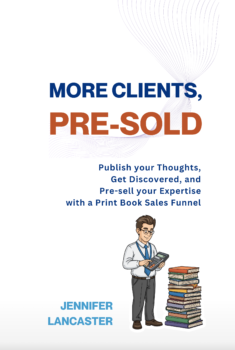
A published nonfiction book (like More Clients, Pre-Sold or My Personal Brand) carries a level of perceived authority that no digital freebie can replicate. When a reader receives your book, even as a first chapter, they’ve already made a small commitment: they gave you their attention for longer than 90 seconds. That matters enormously in conversion psychology. Free chapter opt-ins on a targeted landing page typically convert at 2 to 5 per cent, which is lower than a checklist, but the downstream client conversion from book readers is dramatically higher. Those readers arrive at a sales conversation already inside your framework.
Consider the case of a business coach I helped last year. The author is now reaping the rewards of newly-impressed readers who can now see beyond her as a bookkeeper/agent to the business strategy and reasoning, at least in WA. That is what a well-designed business book does: it positions you as the obvious next step so that by the time a reader reaches out, the conversation is about logistics, not convincing.
The key word there is “well-designed”. A book that earns trust at that level isn’t written by accident. It’s built with a specific structure that moves a reader from problem awareness through to solution confidence, with your services as the natural conclusion.
Designing your book as lead magnet to funnel readers toward your services
Book structure is lead generation strategy. Most business authors think about calls to action as a marketing afterthought, something tacked on at the end of the manuscript once the real writing is done. That’s the wrong approach. The back matter of your book is the most underused conversion tool in a business author’s arsenal, and it should be planned before you write a single chapter.
Calls to action belong in several specific places. The end of each key chapter, particularly those that solve a partial problem, is a natural moment to invite readers to take the next step. The conclusion carries even more weight: readers who finish your book are warm, engaged, and ready to act. A dedicated resources or next steps section in the back matter can direct them to your website, your email list, your programme, or a discovery call. Your author note or preface, meanwhile, can invite readers into a community or free resource before they’ve even read chapter one.
Mapping your framework to the manuscript
At Business Author Academy, one of the first things I do with every author is map their signature framework and identify exactly where in the manuscript it needs to appear. The aim is to create a reading experience where the problem is introduced, the solution is demonstrated, and the reader arrives at the final page genuinely wanting to work with you. A book designed this way doesn’t just build credibility, it builds demand. That distinction is the entire difference between a book that gathers dust and one that generates leads.
Choosing the right book-based lead magnet format
Not every author is at the same stage, and the format you choose should match where you are in your publishing journey. There are three main options for nonfiction business authors.
- Free first chapter: Low cost to produce, converts at 3 to 5 per cent on a dedicated landing page, and works well as a top-of-funnel sample for an existing published book. It lets potential readers taste your voice and methodology before committing.
- Full book giveaway (digital): Higher perceived value and ideal for coaches using the book as a client acquisition tool rather than a product. This works best when you want depth of trust and don’t mind the fact it is not directly earning.
- Short lead-magnet report/ebook (3,000 to 12,000 words): Not as good as converting fly-by visitors these days, but that all depends on the topic. Best when your full manuscript isn’t ready but you want to start building your list now. One author peer gave away worksheets in Excel–which worked really well for these startup founders.
Incidentally, the average pop-up form converts at 3.09 percent, with top-performing pop-ups converting at 9.28 percent
For most business authors, I recommend the full book (watermarked) or a substantial first chapter. The depth drives trust in a way that shorter formats simply can’t replicate. For file formats, default to PDF for nonfiction: the layout is consistent, it opens on any device, and it reads professionally. Add EPUB as a strong second option for mobile readers who prefer reflowing text. For a free chapter, aim for 10 to 25 polished pages. For a short lead-magnet ebook, 3,000 to 12,000 words is the sweet spot, substantial enough to feel valuable without demanding too much time from a busy professional reader.
Delivering your book as a lead magnet and building your list
The delivery experience matters more than most authors realise. A clunky download process or a broken link can undo all the trust your cover and title worked to build.
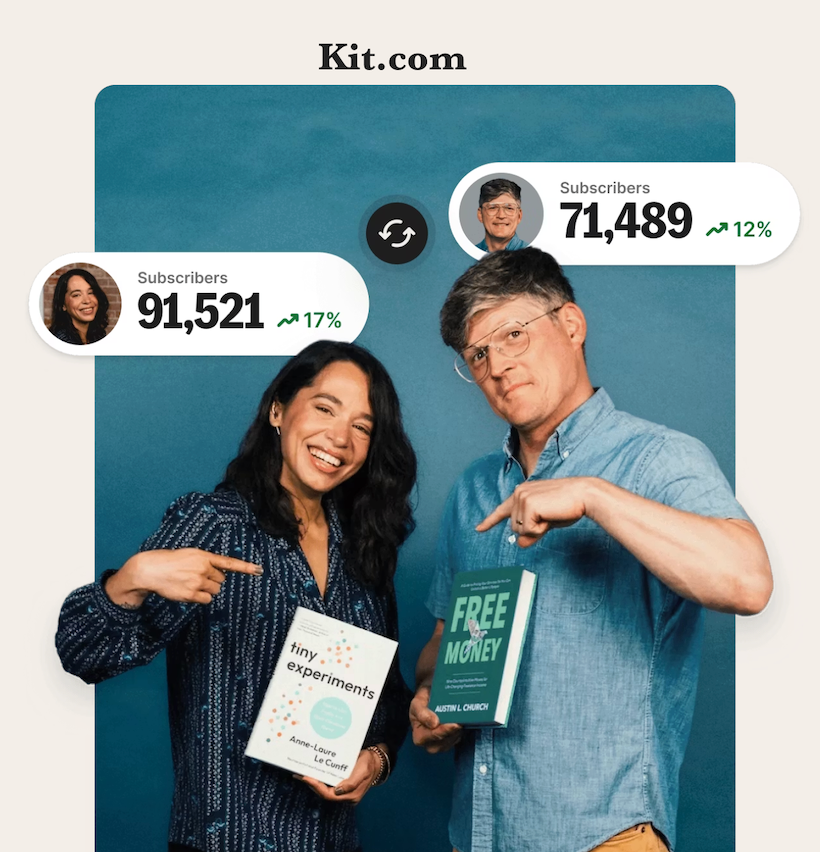
BookFunnel is a well-regarded option for authors: it handles multiple formats, provides a polished reader experience, and integrates directly with email platforms. Pair it with KIT (free up to 1,000 subscribers, with strong automation tools as your list grows) for tagging, segmentation, and welcome sequences.
For single-tool setup, Kit.com handles PDF delivery and list capture in one place.
StoryOrigin is a lower-cost alternative worth considering if you’re just starting out and keeping overheads tight.
Your landing page is where the opt-in either happens or it doesn’t, so every element needs to earn its place. Think of it as six non-negotiables working together:
- A promise-led headline that names the outcome
- A large cover image above the fold
- Three to five benefit bullets
- One primary CTA repeated twice on the page
- A short trust section with your credentials and any social proof
- A simple form asking for email only
Keep the form friction low. Every additional field you add costs you subscribers.
CTA phrases that perform for nonfiction authors
For author lead magnets, these CTA phrases consistently perform well: “Download the free chapter,” “Get the book and workbook,” and “Access the first 30 pages now.” Each one makes the action clear and the value immediate. Avoid vague CTAs like “sign up” or “subscribe.” Tell readers exactly what they’re getting and frame it as an asset, not a newsletter.
Distributing your book lead magnet beyond your website
A landing page alone won’t build a list. Your reader magnet needs to appear everywhere you already have attention. The channels that work consistently for business authors include speaking engagements and slide decks, podcast interviews as the closing call to action, social media bios and content posts, guest articles and column bylines, and email signatures. Each of these is a placement opportunity that costs nothing beyond the time to set it up.
One of the most overlooked tactics is placing the subscriber invitation inside the printed book itself. A reader who buys your book at a speaking event or through Amazon can become an email subscriber and warm lead through a well-placed back matter QR code. The code takes them directly to the landing page. The print book becomes a self-contained lead generation loop.
To know whether your book lead magnet is doing its job, track three numbers. Your landing page opt-in rate tells you how well cold and warm traffic converts, aim for 2 to 5 per cent on cold, higher on warm. Your welcome email open rate signals whether the people joining your list are genuinely interested. Your downstream enquiry or discovery call rate within 30 days of subscription reveals whether your book is functioning as a business asset or simply as a product. Together, these metrics tell the whole story.
Your book can do the selling before you say a word
Return for a moment to that fear I mentioned at the start: the worry that writing a whole book might be a vanity exercise while your PDF does the heavy lifting. A book designed with conversion in mind, built around your signature framework or life lessons and distributed strategically, is the most powerful book a coach or consultant can create. As a lead magnet, it does the work of building trust and demonstrating expertise before a single sales conversation happens.
This doesn’t happen by accident. It’s the result of intentional decisions made during the writing and editing process, decisions about structure, placement, back matter, and the reader journey from first page to discovery call. That’s exactly what we focus on at Business Author Academy. From manuscript mapping through to back matter CTAs and launch strategy, the entire process is designed to make sure your book works as a business asset, not just a product on a shelf.
If you’re ready to find out which format and approach suits your book and your business goals, reach out to book a discovery call. Alternatively, browse the free writing resources on the blog, practical tools you can apply to your manuscript this week. Your book isn’t a vanity project. In the right hands, it’s your most effective salesperson.