
This freehand style of mapping seems to works best over all other brainstorm methods. People seem to start wide and then end up finding their book idea hiding in the subtopics (branches).
How to Plan your Book that Builds your Business: Article 3. Reading time: ~5 minutes.
From a Mind Mapping book read in 1996 – to my primary creative structuring tool in 2026 – the Tony Buzan Mind Mapping® method has become a refreshing way for me to un-muddle my thinking and book topic planning.
To pin down a reason why it works so well, from what I’ve read, it is the way it aligns with our brain’s ‘radiant thinking’ style. Our brain works in a non-linear way. The brain loves keywords too, words which connect to meanings created in our mind. This is called semiotics.
“Radiant Thinking… refers to associative thought processes that proceed from or connect to a central point”.
(Tony Buzan).
What is Radiant Thinking? (external link to article)

The Problem with Starting out in Mind Mapping (for Books)
The main problem with starting is: having a fixed topic in mind. I found you must be flexible with your main topic (title) for your book or thesis. It is a discovery process, and sometimes it takes two or three go’s to nail that central topic.
For chapters, it takes learning and reading widely on the subject you’re about to structure. It’s kind of like being an AI yourself, but better — you are pairing that external worldly knowledge with your personal experience.
Another failure from us wordsmiths is using a word rather than a key central image. Buzan says, “The human brain finds it much easier to remember images than words, and this is why, in a Mind Map, the central key idea is replaced by an image.” (Source: an early Guardian article about using the tool as a career change tool makes for interesting reading).
This image-central-theme is important for memory aid use and problem-solving, but perhaps not so important for sorting out what is in a book or chapter. I put a word and an image.
Are there any Limits to Mind Mapping Freehand?
There is really no limit to what you can use Mind Mapping for. In business it can work for brainstorming new products, task prioritisation, and presentations. In studying, it can help you retain the information (keyword linkage) and in writing, it can help sort the wheat from the chaff (the good from the bland).
Rather than a list of potential chapter names in black text, sparking nothing, the drawing of a Mind Map in colour pens on blank paper allows the maker to spark off the topics in mind with recent readings. A mini lesson on how to mind map appears in my own Mega Book Planning workbook, available directly or free with book coaching. It’s $28.95 + postage.

What Formats does Book Mind Mapping Work With?
Besides researched topics, it also works with collating blog topics-to-book – choosing selected articles for a one-theme book.
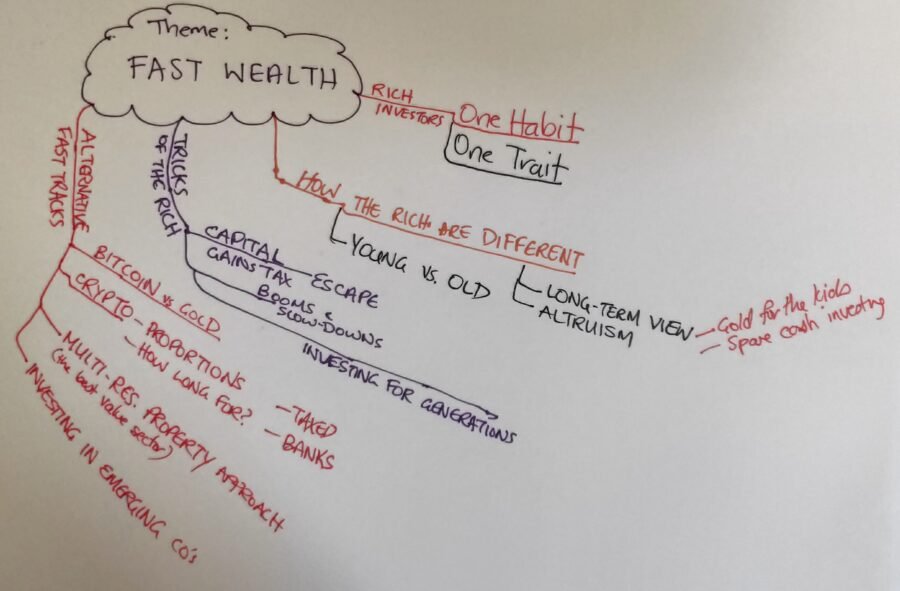
It also works with podcast-to-book theming – I successfully found a theme hiding among a podcast on wealth building.
It also works for neurodiverse brains, like mine for instance. Well, studies have not been done yet specifically for this Buzan Mind Mapping, but I found it helps with organisation of fragmented ideas. I plan to study this in 2027, if accepted.
(Drawing an Ikigai diagram is also useful for finding the right business).
A Potential Side Benefit of Book Brainstorming
Another unresearched side benefit to mind mapping is the return of writers to their own brainstorming and outlining rather than AI. When a novice, it’s tempting to use a chatbot to spirit up a huge list of potential bestselling titles, angles, and wonderful chapter names.
Tempting yes, but aligned? Maybe not. The key is to align the chapter topics with your proven understanding and researched knowledge. When taking a huge body of work and trying to ‘thread a needle’ and confine it to a book, it can lead to overwhelm. Structuring is the same.
With just some minor pointers to my writing mentees, such as ‘do your research first’ and ‘understand the mind of your target reader’, mind mapping makes it much easier to generate the topics and titles aligned with your philosophy.
You’ll never, never know if you don’t give it a go!
Get in touch with Jennifer to learn more about how to write a topical book the easy way.